Cottage food law · Illinois
Illinois cottage food law: what you can sell from home
The Illinois cottage food law lets you make a wide range of homemade food and drink and sell it directly to consumers, at markets, online, by pickup or by delivery. You must register each year with your local health department and hold a certified food protection manager credential. The statute sets no annual sales cap.
Free onboarding. Pay as you use. No monthly fee for ordering.
The short version
- Register yearly with your local health department; fee up to $50
- No annual sales cap in the statute; online, delivery and pickup are named
- A certified food protection manager credential is required
Illinois at a glance
Checked November 2026- The law
- Cottage food operation (410 ILCS 625/4, as amended by the Home-to-Market Act, Public Act 102-0633)
- Sales cap
- No annual dollar cap in the statute.
- Registration or permit
- Required: register with your local health department each year; you receive a registration number.
- Fee
- Local health department may charge up to $50 (statute as enacted in 2021).
- Selling online
- Allowed (sales at or through fairs, festivals, public events or online); a home-kitchen notice must appear at the online point of sale.
- Delivery
- Delivery to the customer is allowed.
- Shipping
- Only non-potentially hazardous food may be shipped, sealed to show tampering; no shipping out of state.
- Training
- Department-approved certified food protection manager (ANSI-accredited CFPM) for the person preparing or packaging.
- Label statement
- This product was produced in a home kitchen not inspected by a health department that may also process common food allergens. If you have safety concerns, contact your local health department.
- In effect
- Home-to-Market Act (Public Act 102-0633) effective January 1, 2022.
Checked against the official source in November 2026. This is a plain-English summary, not legal advice. Rules change, so confirm with your state or county before you sell.
What you can sell
Illinois allows homemade food and drink except a list of prohibited items, under the Home-to-Market Act (Public Act 102-0633, effective January 1, 2022). That covers baked goods, candy, jams and jellies, and, with extra steps, some canned and fermented products.
You may can fruit jams, jellies, preserves, fruit butters, syrups, whole or cut fruit in syrup, and condiments such as prepared mustard, horseradish and ketchup. Use Mason-style jars with new lids only. To sell canned tomatoes, you must follow a tested recipe or send your recipe to a lab. Fermented or acidified foods need a tested recipe or a written food safety plan and a pH test.
What you can't sell
The statute lists items you cannot sell unless you are properly licensed for them:
- Meat, poultry, fish, seafood and shellfish
- Dairy, except as an ingredient in a non-potentially hazardous baked good, candy such as caramel, or baked-good frosting such as buttercream
- Pumpkin pie, sweet potato pie, cheesecake, custard and creme pies, and pastries with potentially hazardous fillings
- Low-acid canned foods, sprouts and cut leafy greens (unless dehydrated, acidified or blanched and frozen)
- Cut or pureed fresh tomato or melon, wild-harvested mushrooms
- Alcoholic beverages and kombucha
- Take-n-bake products, which need temperature control
Registration, training and costs
You must register with the local health department for the unit of local government where you live, but you can sell outside that area. The department issues a certificate with a registration number. Registration is completed annually and the statute lets the department charge a fee of up to $50. Your department publishes its own fee and steps, and may allow self-certification.
The person who prepares or packages the food must be a Department-approved certified food protection manager. University of Illinois Extension says that means an ANSI-accredited Certified Food Protection Manager course and exam.
A health department may require a water test if you use a private well, and a lab check for baked goods with cheese. In a complaint or outbreak, the state or local department may inspect your premises, set a reasonable inspection fee, and stop sales.
Where and how you can sell
Food must be sold directly to consumers for their own use, not for resale. The statute names these routes:
- Farmers' markets
- Fairs, festivals, public events or online
- Pickup from your home or farm, if local law does not prohibit it. In a city of 1,000,000 or more such as Chicago, follow the city's home-based business laws.
- Delivery to the customer
- Pickup from third-party private property, with the owner's consent
Shipping
Only non-potentially hazardous food may be shipped, and cottage food may not be shipped out of state. Each shipped product must be sealed in a way that shows tampering, such as a sticker or pop top.
Labels
Packaging must follow the Illinois Food, Drug and Cosmetic Act, and the product must be prepackaged with a prominent label. The statement reads: "This product was produced in a home kitchen not inspected by a health department that may also process common food allergens. If you have safety concerns, contact your local health department."
At the point of sale you must also display a notice: "This product was produced in a home kitchen not inspected by a health department that may also process common food allergens." Online, that notice is a message on your sales page at the point of sale.
- Your operation's name and the unit of local government where it is located
- Your registration number and the municipality or county where you registered
- The common name, and all ingredients in descending order by weight
- The date the product was processed
- Allergen labeling under federal rules (name tree nuts specifically)
- A home address is not required
Getting started checklist
- Take an ANSI-accredited Certified Food Protection Manager course and pass the exam.
- Call your local health department for its registration form and fee.
- Check that none of your products are on the prohibited list.
- Print labels with your registration number and the exact statement.
- Add the point-of-sale notice to your online checkout.
- Check city rules if you pick up from home or live in Chicago.
- Renew your registration every year.
How pickup.kitchen fits the Illinois rules
Illinois names online sales, home pickup and delivery to the customer in the statute, so every part of pickup.kitchen has a place. You get yourname.pickup.kitchen with a menu, checkout and payments to your own Stripe account.
The statute asks for a message at the point of sale online. Put the home-kitchen sentence in each dish description so it shows before checkout. Pickup windows, slots that close when full and order cutoffs run a weekly drop.
The delivery tools plan your route and send it to a driver's phone, with a photo at the door, for the delivery-to-the-customer route. Your customer list keeps every buyer and order. Only ship non-potentially hazardous food, and never out of state. Free onboarding, pay as you use.
What we checked, and when
Checked November 2026 against the official Illinois sources linked below. Laws change, so open the official page before you print labels or take your first order.
This is a plain-language summary, not legal advice. Check with your state and county before you sell.
Real screens
Take orders from your home kitchen
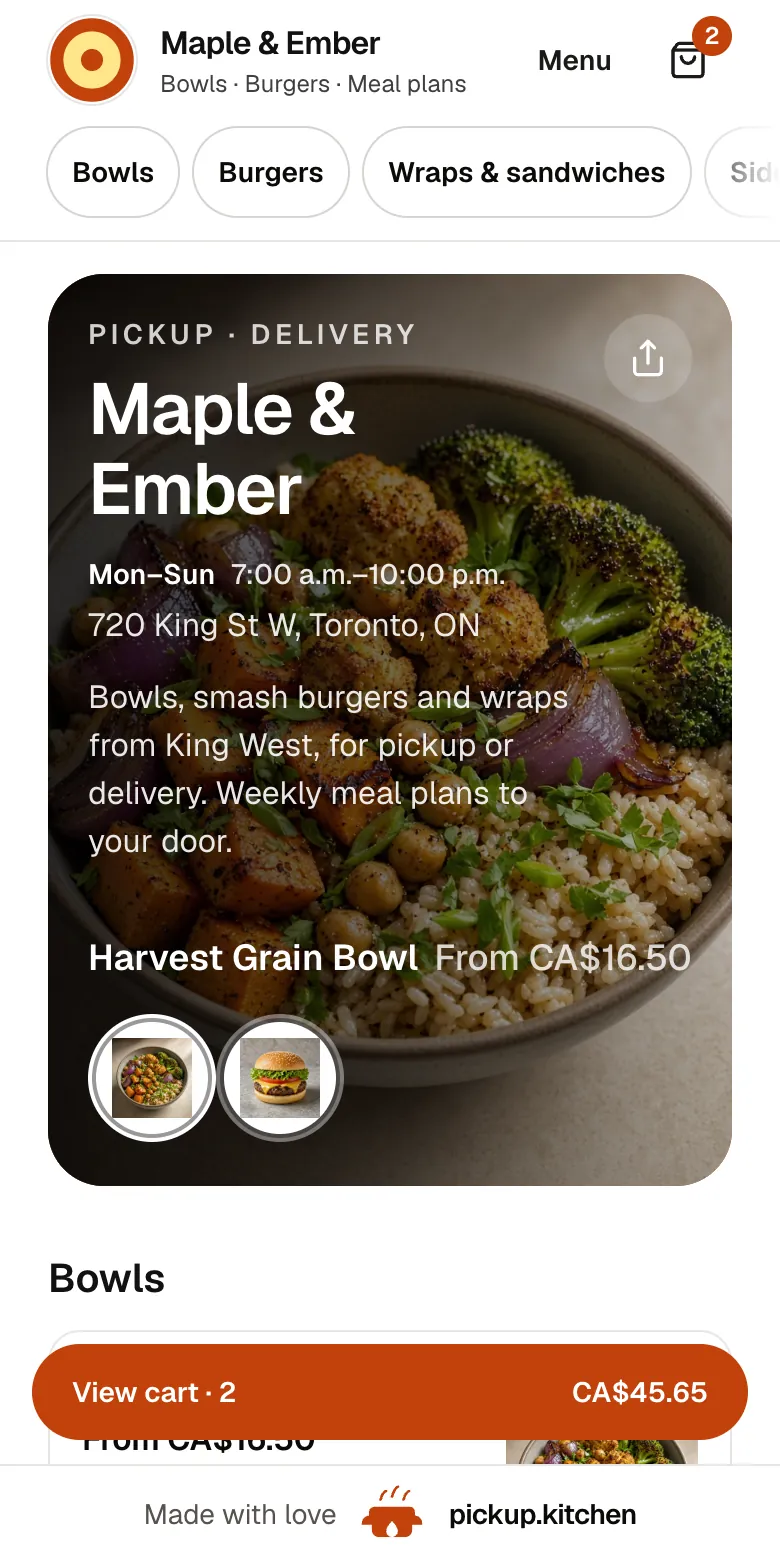
1Your guests
Your menu, on your own site
yourname.pickup.kitchen shows your dishes with photos and prices, and each guest picks pickup or delivery.
See how it works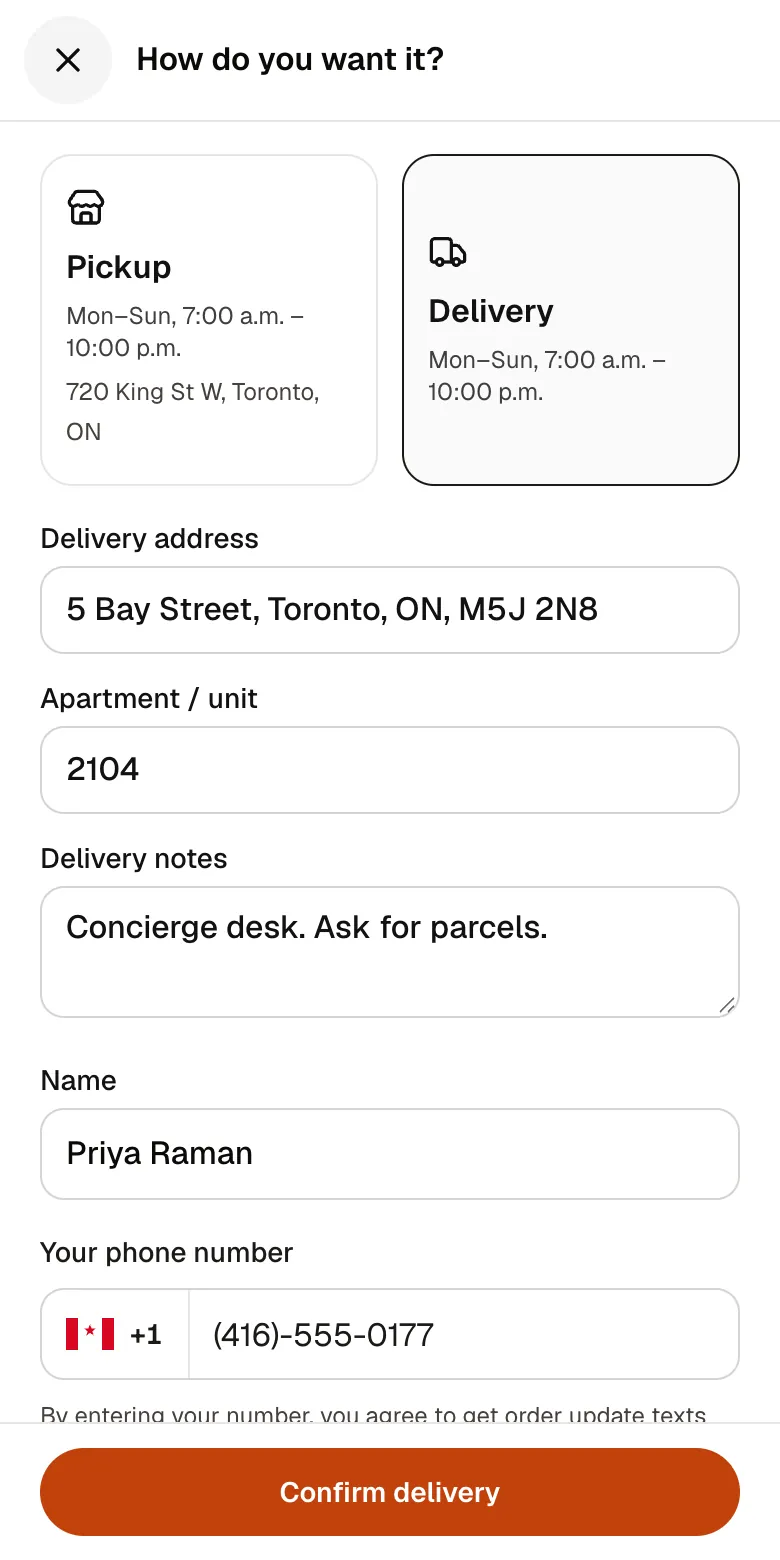
2Your guests
A checkout that takes seconds
A pickup time or a delivery address, then pay by card. No app to install and no account before paying.
See how it works
FAQ
Questions
Do I need a license to sell baked goods from home in Illinois?
You register with your local health department instead of getting a state license. Registration is annual, the department may charge up to $50, and you need a certified food protection manager credential.
Is there a sales limit for Illinois cottage food?
The statute, as amended by the Home-to-Market Act effective January 1, 2022, sets no annual dollar cap. Check your local health department in case it has added conditions.
Can I sell cottage food online in Illinois?
Yes. The statute lists sales at or through fairs, festivals, public events or online. You must show the home-kitchen notice on your online sales page at the point of sale.
Can I ship cottage food in Illinois?
Only non-potentially hazardous food may be shipped, it must be sealed to show tampering, and it cannot be shipped out of state.
Can I sell cottage food to stores in Illinois?
No. Illinois cottage food must be sold directly to consumers for their own consumption and not for resale. The IDPH page also says it may not be sold for resale or in retail food establishments.
What does an Illinois cottage food label need to say?
Your operation's name and local government unit, registration number and county or municipality, the product name, ingredients, the processing date, allergens, and the statement that the product was produced in a home kitchen not inspected by a health department.
Keep reading
- GuideCottage food laws by state: caps, permits, online salesCottage food laws explained: what they are, the rules most states share, how to start selling from home, and a 15-state table of caps and permits.
- By businessSell food from home: your own ordering pageSell food from home with a weekly menu, an order cutoff and pickup windows on your own link. Cottage food rules explained. Free onboarding, 10% per order.
- GuideHow to start a bakery business from homeHow to start a bakery business from home: check your cottage food rules, pick bakes that qualify, label and price them, take pre-orders. Steps and sources.
- ProductOnline ordering system for restaurantsAn online ordering system for restaurants: your own site at yourname.pickup.kitchen, time slots that close when full, and a kitchen screen. 10% per order.
- By businessBakery POS with online pre-ordersBakery POS that takes counter sales and online pre-orders on one menu, with pickup windows, an order cutoff and a stock count for each item. 10% per order.
Free onboarding. Pay as you use.
Take orders from your home kitchen
Set pickup windows and delivery, publish your label details, and take your first orders on your own site.