Cottage food law · California
California cottage food law: Class A and Class B
The California cottage food law, the California Homemade Food Act, lets you make approved foods in your home kitchen and sell them. You must register or get a permit from your county first. Class A operators sell directly to customers, up to $88,878 in 2026. Class B operators can also sell through restaurants and shops, up to $177,756.
Free onboarding. Pay as you use. No monthly fee for ordering.
The short version
- Class A registers with the county; Class B gets a county permit
- 2026 limits: $88,878 (Class A) and $177,756 (Class B), adjusted yearly
- Direct sales can be fulfilled in person, by mail or by a delivery service
California at a glance
Checked November 2026- The law
- Cottage Food Operation, Class A and Class B (California Retail Food Code; California Homemade Food Act)
- Sales cap
- 2026 adjusted limits: $88,878 (Class A) and $177,756 (Class B). Statute base: $75,000 and $150,000, adjusted yearly for inflation.
- Registration or permit
- Class A: register with your local enforcement agency (county environmental health) with a self-certification checklist. Class B: permit from the local agency. CDPH does not register or permit.
- Fee
- Set by your county; CDPH lists no fee.
- Selling online
- Allowed: direct sales include transactions by phone, internet and other digital methods (Class A and B).
- Delivery
- A direct sale may be fulfilled in person, by mail delivery or by any third-party delivery service, within California.
- Shipping
- Mail delivery allowed within California.
- Training
- Food processor course within 3 months of registration or permitting, then every 3 years (an ANSI-accredited food handler course counts).
- Label statement
- "Made in a Home Kitchen" (or "Repackaged in a Home Kitchen"), 12-point type on the principal display panel, plus your registration or permit number and issuing county.
- In effect
- 2026 adjusted sales limits effective January 1, 2026. AB 1144 changes effective January 1, 2022. CDPH notice proposes adding chocolate and nut spread to the approved list (new list about November 16, 2026).
Checked against the official source in November 2026. This is a plain-English summary, not legal advice. Rules change, so confirm with your state or county before you sell.
What you can sell
California only allows foods on the Approved Cottage Food List, which the California Department of Public Health (CDPH) maintains. The foods are non-potentially hazardous: they stay safe without refrigeration. Check your exact product against the list before you register.
CDPH's FAQ gives examples. Eggs are fine in a cookie or a cake mix because the baked product is dry and needs no refrigeration, but not in a custard or lemon curd.
CDPH posted a notice to add "Chocolate and Nut Spread" to the nuts, nut mixes and nut butters category. It says the new list will be posted on or about November 16, 2026.
What you can't sell
CDPH explains why some popular items are not approved. If a product is not on the list, you can ask CDPH to add it with form CDPH 8764.
- Salsa: cut tomatoes vary in acidity and are treated as potentially hazardous
- Pickles, hot sauce and other canned low-acid or acidified foods, because of botulism risk
- Pumpkin and sweet potato pie, and other custard pies made with milk and eggs
- Pepper jelly, because peppers are low-acid
- Any food not on the Approved Cottage Food List, until CDPH adds it
Registration, permits and costs
CDPH does not issue cottage food permits or registrations. Your local enforcement agency, usually the county environmental health department, does. CDPH does not list a fee, so ask your county what it charges.
A Class A operator must register with the local agency and submit a self-certification checklist. A Class B operator must get a permit from it.
Every operator must take a food processor course within three months of registering or being permitted, and again every three years. A food handler course from an ANSI-accredited provider meets the rule. Keep the certificate for every person who prepares or packages food.
A cottage food operation may have no more than one full-time-equivalent employee, not counting family or household members.
Sales limits for Class A and Class B
The statute sets base limits of $75,000 for Class A and $150,000 for Class B, adjusted every year for inflation using the California Consumer Price Index. CDPH's adjusted table lists $88,878 for Class A and $177,756 for Class B, effective January 1, 2026.
CDPH's main cottage food page still shows the base figures of $75,000 and $150,000. The adjusted table is CDPH's own newer document, so use it, and confirm the number with your county.
Where and how you can sell
Class A can make direct sales only, to consumers in California. CDPH says that "includes transactions made via the phone, internet, and any other digital method," and a direct sale "may be fulfilled in person, via mail delivery, or using any other third-party delivery service." CDPH's examples include farmers' markets, bake sales, farm stands and community-supported agriculture subscriptions.
Class B can make direct sales and indirect sales, where a restaurant, food market or other permitted retailer sells your product to the customer. Indirect sales can also be fulfilled in person, by mail or by a delivery service.
Labels
CDPH's labeling sheet lists what must be on every label. The words "Made in a Home Kitchen" (or "Repackaged in a Home Kitchen") go on the principal display panel in 12-point type.
- The common name of the food
- Your name, city and zip code; a street address too if you are not in the phone directory
- Your registration or permit number and the county that issued it
- Ingredients in descending order by weight
- Net quantity in English and metric units
- A plain-language allergen declaration
- A Nutrition Facts panel only if you make a nutrient content or health claim
Getting started checklist
- Check every product against the Approved Cottage Food List.
- Pick Class A (direct sales only) or Class B (direct and indirect).
- Call your county environmental health department and ask for its registration or permit steps and fee.
- Take an ANSI-accredited food handler course within three months of registering.
- Follow the six kitchen rules: no pets or small children in the kitchen while you work, sanitize everything, and no smoking.
- Print compliant labels with your registration number and county.
- Track gross sales against your class limit.
How pickup.kitchen fits the California rules
California's definition of a direct sale already covers internet orders, mail and third-party delivery, so an online ordering site fits Class A and Class B. pickup.kitchen gives you yourname.pickup.kitchen with checkout, a menu with photos, and payments to your own Stripe account.
CDPH lists community-supported agriculture subscriptions as a direct sale, so a weekly drop that customers pre-order works the same way. Use time slots that close when full, sold-out days and closed dates to keep batch sizes honest.
Your customer list holds every buyer and their orders, which helps when you total your sales against the limit for your class. Delivery tools plan the route if you drive the orders yourself. Free onboarding, pay as you use.
What we checked, and when
Checked November 2026 against the official California sources linked below. Laws change, so open the official page before you print labels or take your first order.
This is a plain-language summary, not legal advice. Check with your state and county before you sell.
Real screens
Take orders from your home kitchen
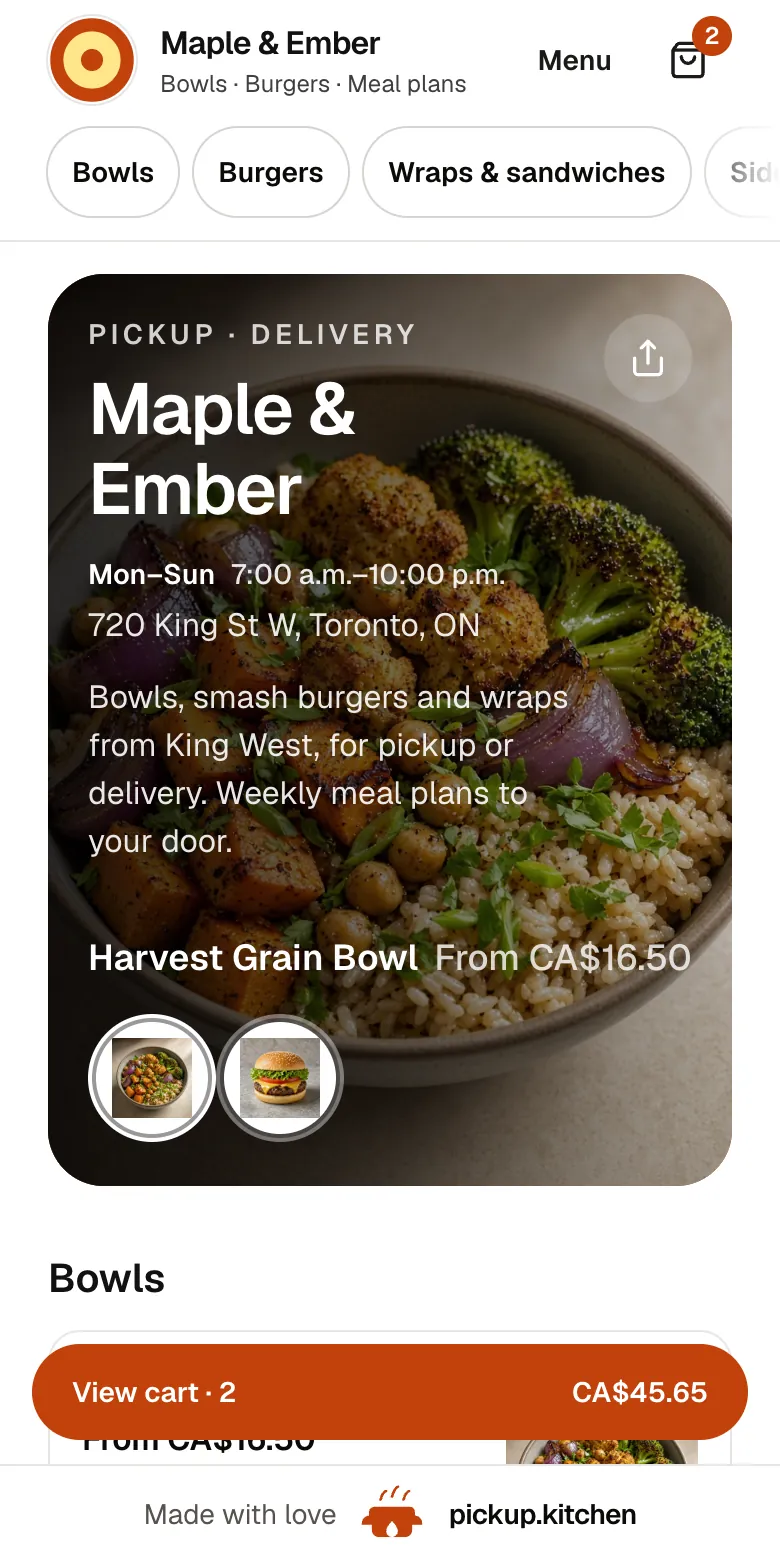
1Your guests
Your menu, on your own site
yourname.pickup.kitchen shows your dishes with photos and prices, and each guest picks pickup or delivery.
See how it works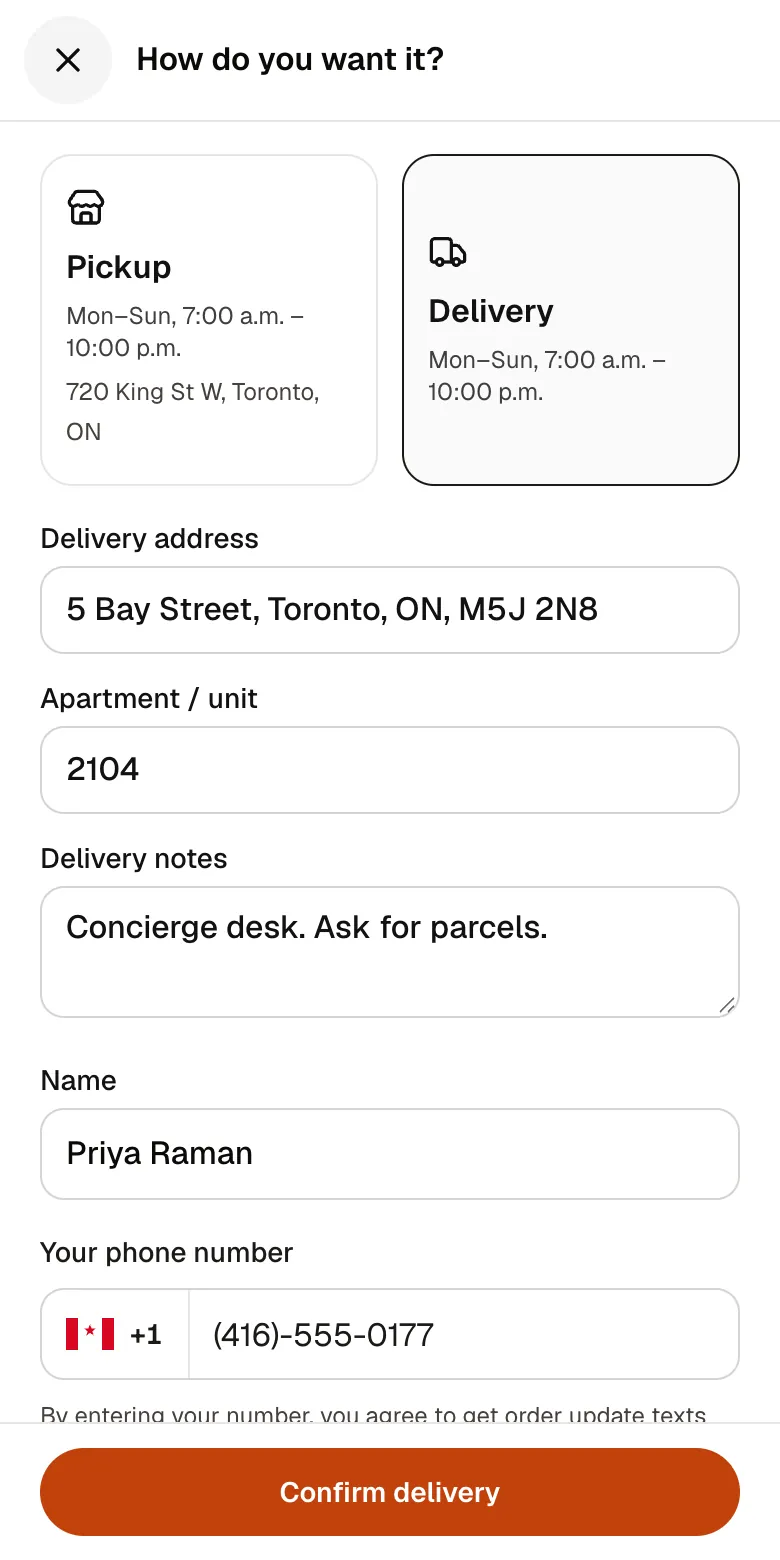
2Your guests
A checkout that takes seconds
A pickup time or a delivery address, then pay by card. No app to install and no account before paying.
See how it works
FAQ
Questions
Do I need a permit to sell baked goods from home in California?
Yes. Class A cottage food operations register with their local enforcement agency, and Class B operations get a permit from it. CDPH does not issue either one. Contact your county environmental health department.
How much can a cottage food business make in California?
CDPH's adjusted table lists $88,878 for Class A and $177,756 for Class B in 2026. The statute's base limits are $75,000 and $150,000, adjusted yearly for inflation.
Can I sell cottage food online in California?
Yes. CDPH says direct sales include transactions by phone, internet and other digital methods, and they can be fulfilled in person, by mail delivery or by a third-party delivery service. Sales must be within California.
Can I sell cottage food to restaurants or stores in California?
Only as a Class B operator, which allows indirect sales through restaurants, food markets and other permitted retailers. Class A is limited to direct sales.
What is the difference between Class A and Class B cottage food in California?
Class A registers with the county, sells direct to consumers only, and has the lower sales limit. Class B holds a county permit, can sell direct and indirect, and has the higher limit.
Do I need a food handler card for a California cottage food business?
Yes. Anyone who prepares or packages cottage food must complete a food processor course within three months of registering or being permitted and every three years after. An ANSI-accredited food handler course counts.
Keep reading
- GuideCottage food laws by state: caps, permits, online salesCottage food laws explained: what they are, the rules most states share, how to start selling from home, and a 15-state table of caps and permits.
- By businessSell food from home: your own ordering pageSell food from home with a weekly menu, an order cutoff and pickup windows on your own link. Cottage food rules explained. Free onboarding, 10% per order.
- GuideHow to start a bakery business from homeHow to start a bakery business from home: check your cottage food rules, pick bakes that qualify, label and price them, take pre-orders. Steps and sources.
- ProductOnline ordering system for restaurantsAn online ordering system for restaurants: your own site at yourname.pickup.kitchen, time slots that close when full, and a kitchen screen. 10% per order.
- By businessBakery POS with online pre-ordersBakery POS that takes counter sales and online pre-orders on one menu, with pickup windows, an order cutoff and a stock count for each item. 10% per order.
Free onboarding. Pay as you use.
Take orders from your home kitchen
Set pickup windows and delivery, publish your label details, and take your first orders on your own site.